A data-centre campus can enter a utility forecast as a block of demand larger than a town. It may be expected to run around the clock and connect faster than new transmission and generation can usually be built. For power planners, the growth of artificial intelligence is already measured in megawatts.
The International Energy Agency’s 2026 update estimates that data centres used about 485 terawatt-hours of electricity worldwide in 2025. Its central projection puts consumption at 950 TWh in 2030, about 3 per cent of global electricity use. Demand from AI-focused data centres is projected to triple over the same period. The IEA describes those figures as scenarios and stresses the uncertainty around them. Current consumption is moving quickly: data-centre electricity use grew 17 per cent in 2025, while total global electricity demand grew 3 per cent.
A Lawrence Berkeley National Laboratory study for the US Department of Energy estimated that American data centres consumed 176 TWh in 2023. That was 4.4 per cent of national electricity use, up from 1.9 per cent in 2018. The report projected consumption of 325 to 580 TWh in 2028, or 6.7 to 12 per cent of US electricity demand, depending on equipment shipments, operating practices and cooling.
Forecasting a load that may move
The wide range in the Berkeley Lab projection defines the planning problem. Utilities must decide on long-lived investments before they know which announced campuses will be built, how efficiently the equipment will operate, how intensively processors will run or whether a customer will relocate. Too little capacity can delay connections. Too much can leave other customers paying for wires and generation built for demand that never arrived.
Improving efficiency will change these forecasts. Total demand could still rise. According to the IEA, the electricity required for an individual AI task is falling rapidly. Cheaper and more capable systems can also create more uses, including agents that perform repeated or continuous work. Energy use per task may fall while the number of tasks rises.
The grid enters the compute supply chain
The IEA’s 2025 base case projected that electricity generation serving data centres would grow from about 460 TWh in 2024 to more than 1,000 TWh in 2030. Renewables supply nearly half of the additional power in that case, followed by natural gas and coal. Nuclear power takes a larger role later in the decade. In a faster “lift-off” scenario, long connection queues lead fossil generation to meet more of the increase. The emissions depend on the location and timing of new campuses as well as their total demand.
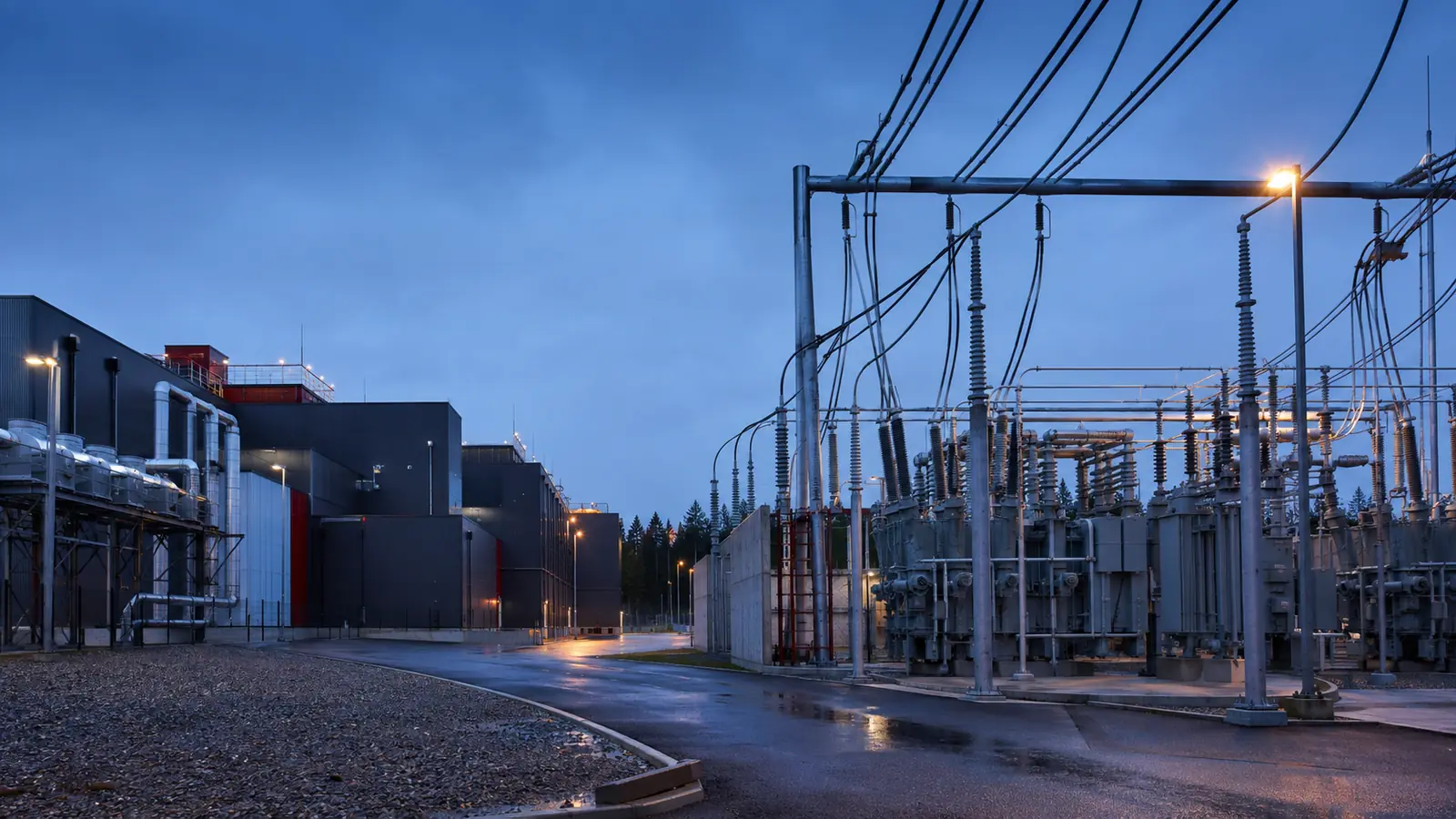
Data centres tend to cluster where fibre, land, tax treatment and existing grid capacity are available. A national power system may have sufficient annual energy even when a particular region lacks the substation, transformer or transmission path needed at the requested place and hour. In April 2026, the IEA reported tighter supply chains for transformers and gas turbines. It also found that project pipelines were straining planning, connection and permitting systems.
The US Department of Energy’s draft July 2026 National Transmission Needs Study lists new large loads, generator interconnection and congestion among the reasons for additional transmission. Building a line requires route studies, cost allocation, permits, equipment, construction and coordination across jurisdictions. The data hall may be ready before the network that will supply it.
Who pays for the connection
The difference in construction schedules is influencing electricity tariffs. Berkeley Lab’s review of large-load rate design describes minimum-demand charges, collateral requirements, long contracts and provisions covering study costs. Such terms assign more of the financial risk to the customer requesting the capacity. If a utility builds for a forecast 500-megawatt campus and the customer uses half of it or leaves, the contract determines how much of the remaining cost reaches household bills.
Contracts can also pay for flexibility. A data centre may be able to reduce demand during a tight hour, shift some computing, use storage or increase its load gradually. Latency-sensitive services and reliability commitments limit how far those measures can go. Onsite generation may support reliability. It can also increase local pollution or avoid shared grid costs when rules are weak. Utilities need measurable commitments that they can dispatch. Promises in sustainability reports do not provide that assurance.
Regulators now have to test each project’s load forecast, connection costs, flexibility and proposed power supply. Transparent queues can remove speculative projects. Regional forecasts can show where several large requests compete for the same equipment or transmission. Long-term contracts can protect existing customers if a developer changes its plans.
AI tools may help utilities forecast faults, optimise operations and use existing lines more fully. Those gains will take place within a system still constrained by transformer delivery times, permitting and the politics of transmission routes.
Every large connection agreement makes practical choices about capacity, cost and timing. Those terms will decide which campuses connect, what generation serves them and who pays when a forecast proves wrong.