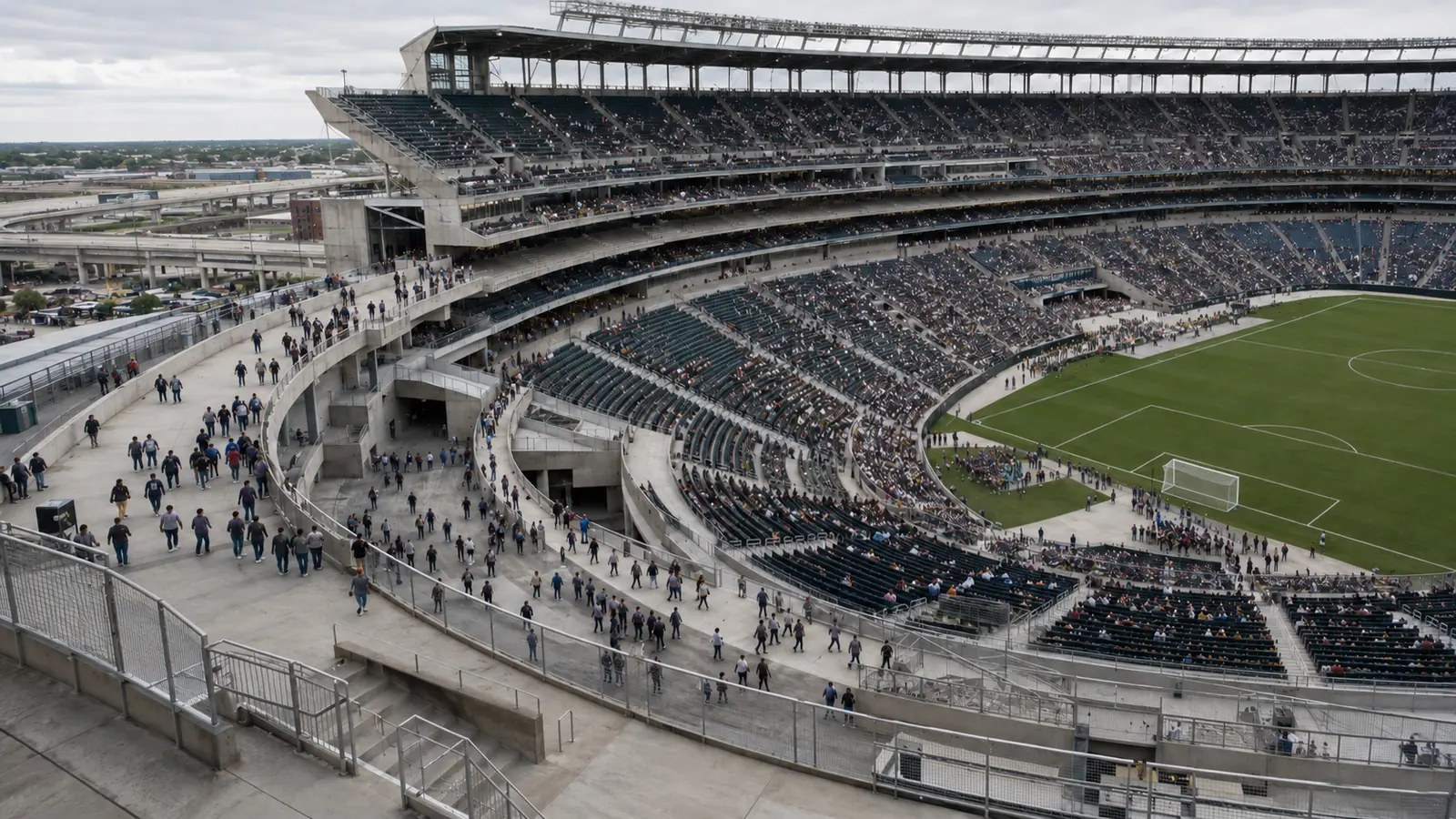
Spain’s victory over Argentina on 19 July closed the first 48-team men’s World Cup. FIFA’s post-final summary reported 104 matches, 308 goals and 6,810,966 spectators across 16 stadiums in Canada, Mexico and the United States. The tournament lasted 39 days. Compared with Qatar 2022, the new format added 16 teams and 40 matches, as well as an extra knockout round.
The 308 goals produced an average of 2.96 per match. FIFA’s 2022 annual report recorded 172 goals in 64 matches, an average of 2.69. On those totals, the scoring rate increased by about ten per cent. Goal averages provide one measure of the event. A fuller assessment of match quality would also require chance creation, competitiveness, game state and tactical data.
Expansion changed the knockout field
The format placed 48 teams in 12 groups of four. The top two in each group and the eight strongest third-place teams advanced to a new Round of 32. The group stage contained 72 matches, eight more than the whole 2022 tournament, and sent two-thirds of the field into the knockouts. Spain and Argentina each played eight matches on their way to the final. Previous finalists played seven.
FIFA reported that the knockout field included 13 UEFA teams, nine CAF teams, five CONMEBOL teams, three Concacaf teams and two AFC teams. Nine of Africa’s ten entrants advanced. Before 2026, at most two African teams had reached the knockout phase at a single men’s World Cup. Bosnia and Herzegovina, Cabo Verde, Canada, Congo DR, Côte d’Ivoire, Egypt and South Africa reached that stage for the first time.
Cabo Verde, Curaçao, Jordan and Uzbekistan made their World Cup debuts. Cabo Verde also progressed from its group without a defeat. These results show how expansion widened access: more national teams entered the tournament, and several new entrants remained competitive beyond qualification.
The group stage also produced a 7–1 German victory over Curaçao, one result that showed a large competitive gap. Across all 72 group matches, 47 of 48 teams scored and the phase produced 215 goals, just under three per game. FIFA’s Technical Study Group said the quality gap had narrowed. Its analysts work for the tournament organiser, so their conclusion will be easier to assess when FIFA publishes fuller technical data.
Scoring and attendance
FIFA’s analysts identified two further trends during the competition. At the end of the group stage, winning teams were regaining the ball an average of four seconds faster than losing teams. Before the final, FIFA’s chief of global football development, Arsène Wenger, said the number of goals scored from outside the penalty area had doubled compared with Qatar 2022. Both findings come from the organiser’s performance analysis. They describe possible tactical changes. The public summaries provide too little detail to establish their causes.
FIFA reported group-stage attendance of 4,644,549, average attendance of 64,508 and 99.7 per cent occupancy. The final tournament total gives an average of about 65,490 spectators across 104 matches. Forty additional fixtures and the use of large North American stadiums made a cumulative record more attainable. The reported occupancy rate shows that most available seats were filled across the expanded schedule.
The attendance total is an aggregate figure published by FIFA. Its immediate release gives no account of ticket prices, supporter travel costs, complimentary allocations or people who wanted to attend and could not. It also provides no audited estimate of the economic return to host cities. Those subjects require separate ticketing, transport and public-finance records.
Travel, workload and format
The tournament covered three countries and 16 stadiums, creating a different travel pattern from a compact single-country event. FIFA’s summary celebrates that geographic reach. It does not quantify team flight mileage, supporter journeys, emissions or the public cost of security and transport. Host-city and government reports will be needed to establish those effects.
Player workload also requires evidence beyond the fixture count. The finalists played one additional high-intensity match, and the 39-day tournament sat inside an already crowded club and international calendar. FIFA has supported a minimum of 72 hours between matches and a 21-day rest period at the end of the season. An audit should compare those standards with the recovery time players actually received before, during and after the tournament.
The group rules created a separate trade-off. Advancing 32 of 48 teams kept more countries in contention through the third matchday. It also eliminated only one-third of the field in the opening phase and required a best-third-place table across 12 groups. FIFA chose groups of four partly to reduce the risk of collusion and guarantee three games per team. Complete match data and feedback from teams and supporters would help determine how clearly and fairly the format worked.
As of 20 July, the available record supports several limited findings. The expanded event produced a higher scoring average than 2022, brought seven countries into the knockouts for the first time and filled most reported stadium capacity. FIFA’s own releases supply nearly all of the immediate evidence. Independent figures on cost, travel, player recovery and host-city impact will be necessary for a broader judgement of the 48-team format.